
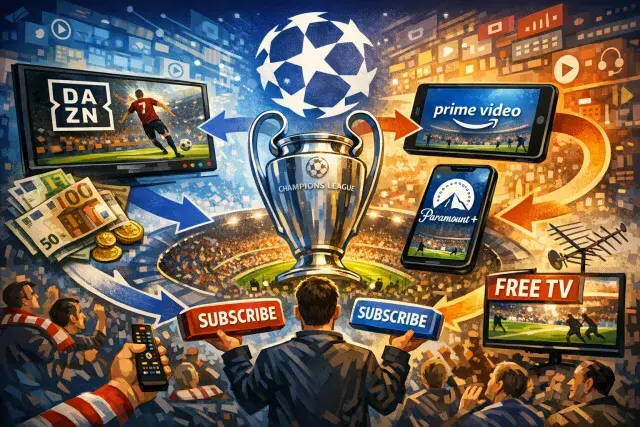

The Champions League remains one of Europe’s most powerful television products, drawing audiences not only because of its history but because access to it is increasingly shaped by platform strategy. In Germany, viewers currently need to follow a split-rights system, with DAZN carrying almost all fixtures until 2027 and Amazon Prime Video holding one exclusive prime midweek selection.
That arrangement matters because it reflects a broader shift in media: major live entertainment is no longer concentrated on a single channel, but distributed across subscription services that compete for attention, recurring revenue and brand loyalty. For audiences, the result is simple to describe and less simple to manage — watching everything often means paying for more than one service.
A historic competition now sits at the centre of streaming economics
Founded in 1955 as the European Cup and rebranded in the early 1990s, the competition has retained a rare cultural weight across generations. Its appeal rests on continuity as much as spectacle: famous nights, familiar anthems, and the recurring presence of Europe’s wealthiest and most decorated clubs. Real Madrid, with 15 titles, stands as the defining institution of that history, while Cristiano Ronaldo holds the leading marks for appearances and goals, according to the figures provided here.
Those records help explain why broadcasters treat the rights as premium inventory. This is not just programming; it is appointment viewing with international reach. That makes it valuable in a crowded streaming market, where platforms need content that can persuade people to sign up immediately and keep paying month after month.
Who shows the fixtures, and why the split matters
Under the current deal, DAZN remains the main outlet through 2027 and shows almost every fixture on television and via livestream. The exception is the exclusive headline selection held by Amazon Prime Video on Tuesday night. If a German club reaches the final, that event will also be available on free-to-air television.
From the 2027/28 cycle through 2030/31, Paramount+ is set to become the main rights holder, while Prime Video will continue with a highlighted midweek exclusive. The outcome is notable for what it says about the market: DAZN did not retain the package beyond 2027, and Sky, once central to pay-TV viewing habits in Germany, secured no rights.
What viewers actually need to know
For most people, the practical question is not institutional history but access. Anyone who wants the broadest possible coverage currently needs DAZN, while viewers interested in the weekly exclusive headline fixture also need Prime Video. SPOX adds another layer by offering live tickers for selected fixtures, providing a useful alternative when full video access is unavailable.
DAZN: main broadcaster until 2027, with almost complete coverage
Amazon Prime Video: exclusive Tuesday headline fixture
Free-to-air television: final available there if a German club is involved
From 2027/28: Paramount+ becomes principal broadcaster
SPOX: live tickers for selected fixtures
The wider significance extends beyond football television
The fragmentation of rights is part of a larger transformation in European media consumption. Premium live events are increasingly used to anchor subscription ecosystems, and rights auctions now influence not only what people watch but how many services they must maintain. That has financial and cultural consequences: loyal audiences face higher cumulative costs, while broadcasters use exclusivity to reshape viewing habits around their own apps and devices.
The Champions League, then, is more than a prestigious annual contest. It is also a case study in how modern media markets package scarcity, loyalty and prestige. For viewers, the essential facts are clear. For the industry, the deeper story is the steady migration of major communal viewing moments from traditional television toward a more fragmented, platform-led future.
