

A virtual private network is no longer a niche tool for security specialists. For many people, it has become a practical service for protecting data on public Wi-Fi, reducing tracking by internet providers and securing connections while streaming, gaming or traveling abroad.
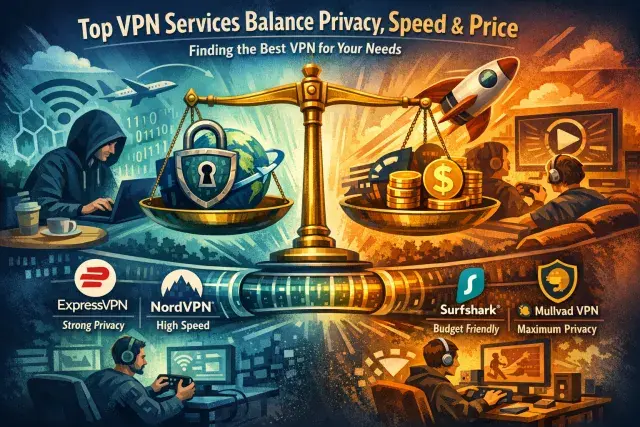
The strongest VPNs do not simply encrypt traffic. They also need to be fast, easy to use and transparent about how they handle customer data. Based on the services described here, ExpressVPN stands out as the best overall option, while NordVPN leads on raw speed, Surfshark offers broad device coverage, and Proton VPN and Mullvad appeal to users who put privacy first.
Why VPN choice now depends on how you go online
VPNs route your internet traffic through an encrypted tunnel, making it harder for outsiders on the same network, or in some cases your internet provider, to inspect what you are doing online. That matters most on hotel, airport and café Wi-Fi, but it also matters at home for people who want more control over their digital footprint.
Not every VPN is built for the same audience. Some prioritize convenience and reliable access to streaming libraries in different regions. Others focus on minimizing the personal information collected at signup or publishing more about their infrastructure and privacy practices. The result is a market where the “best” service depends less on branding than on whether you want speed, anonymity, low cost or the simplest possible app experience.
ExpressVPN and NordVPN lead for mainstream users
ExpressVPN earns the top overall spot because it pairs strong privacy and transparency with software that feels polished rather than technical. It is also well suited to streaming and travel, with servers across all 50 US states, a detail that can help users trying to bypass regional blackout restrictions. Its biggest drawback is price. Even after a recent overhaul, long-term plans remain expensive compared with several close rivals.
NordVPN remains the fastest service in this group, which gives it a clear advantage for 4K video, latency-sensitive online play and large file transfers. It also performs well across the board, from content unblocking to advanced privacy tools. But its value proposition weakens at renewal, when the annual price rises sharply. For users who care about long-term cost, that matters as much as initial promotional pricing.
Lower-cost options make fewer compromises than they once did
Surfshark has become a strong budget-minded alternative, particularly for households with many devices because it is known for generous simultaneous connection support. It does not quite match ExpressVPN on refinement or NordVPN on speed, but it comes close enough that many users may not notice the difference in everyday use. The catch is its monthly plan, which is unusually expensive, making it a better fit for people willing to commit to a longer subscription.
Proton VPN occupies a different position in the market. Its free plan is notable because it avoids the trade-offs that often make no-cost VPNs a poor choice, such as advertising, aggressive data collection or vague ownership. The paid tier then adds a stronger server selection for streaming and travel, while keeping pricing below many premium competitors. For cautious users who want a no-cost entry point without surrendering privacy, Proton has unusual credibility.
For strict privacy, Mullvad keeps the model simple
Mullvad remains one of the clearest examples of privacy by design in consumer software. It does not require an email address or traditional account credentials. Instead, users receive a random account number, reducing the personal data tied to the service from the start. Its flat monthly pricing is also unusually straightforward: no teaser rates, no complicated bundles and no pressure to lock into a multiyear plan.
That simplicity comes with trade-offs. Mullvad is less appealing for people whose main goal is unlocking streaming catalogs across multiple platforms. But for users who see a VPN first as a privacy tool rather than an entertainment accessory, it is one of the most coherent offerings available.
The broader lesson is that VPNs are no longer interchangeable utilities. As online privacy concerns spread and more daily activity depends on stable connections across borders and networks, buyers have to decide what matters most: speed, cost, usability or minimal data collection. The best services now distinguish themselves not just by encryption, but by the trust they ask users to place in them.
